

Quantitative vs Qualitative Research: Choose the Right Method for Your Study
Introduction
Every research journey starts with a question. But before you can answer it, you need to have the correct approach. One key decision – choosing between qualitative vs quantitative research – shapes everything: how you collect data, how you analyze it, and what conclusions you can draw.
Get it right and your research becomes a powerful tool for insight and decision-making. Get it wrong, and you risk drawing conclusions that don’t hold up. Whether you’re a business student working on a dissertation or a professional conducting market analysis, understanding the difference is absolutely vital.
Unsure of where to start? This blog post breaks down both methods clearly, with real examples and practical advice to help you pick the right approach for your study.
What’s more, if you’re exploring why research methodology matters in business, check out Why Research Methods for Business Students Matters? for even more insights.
What is Quantitative Research?
Definition and Key Characteristics
Quantitative research collects and analyzes numerical data using statistical methods. It focuses on measuring variables, identifying patterns and testing hypotheses – producing findings that are objective, replicable and generalizable to a wider population.
Think of it as the “how much” and “how many” approach to research. It’s structured, precise, and works best when you need hard evidence to support a theory or decision.
Sage Journals describes quantitative research as the ‘cornerstone of evidence-based decision-making‘, underlining its clear importance to any research project.
Examples of Quantitative Research
Here are some common quantitative examples for further context:
- Student satisfaction surveys – A university (let’s use UE Amsterdam as an example) surveys 500 students, asking them to rate their learning experience on a scale of 1–10. The results are averaged and compared across departments to identify areas for improvement.
- Market trend analysis – A retail company analyzes 12 months of sales data to identify seasonal purchasing patterns and forecast demand for the coming year.
- Opinion polls – A research firm distributes a structured questionnaire to a representative sample of 1,000 consumers to measure brand awareness before and after an advertising campaign.
- Clinical trials – A pharmaceutical company tests a new medication by comparing measurable health outcomes – such as blood pressure readings or recovery times, across a control group and a treatment group.
Types of Quantitative Research
There are four main types of quantitative research you need to know:
- Descriptive – describes the characteristics of a group or population.
- Correlational – explores relationships between two or more variables.
- Experimental – tests cause and effect through controlled conditions.
- Quasi-experimental – similar to experimental research, but without full randomization.
Common Data Collection Methods
Quantitative vs qualitative methods differ significantly in how data is gathered. For quantitative research, common tools include:
- Closed-ended surveys and questionnaires.
- Structured interviews with fixed-response options.
- Experiments and observation checklists.
- Secondary data sets and statistical databases.
Advantages of Quantitative Research
Quantitative research is often favored for its visual appeal, as numbers and statistics are easy to put into tables and graphs by way of presentation.
- Results are measurable, replicable and easy to compare across studies.
- Works efficiently with large sample sizes.
- Reduces researcher bias through standardized methods.
- Produces data that can be visualized in charts, graphs, and tables.
What is Qualitative Research?
Definition and Key Principles
Unlike quantitative research, qualitative research explores the “why” and “how” behind human behavior. Rather than numbers, this research works with words, themes and meanings – making it the go-to method when context and depth matter more than scale.
Qualitative research is exploratory by nature, flexible in approach and particularly useful when you’re investigating a topic that hasn’t been widely studied before.
Sage Research summarizes qualitative research nicely, in that it ‘offers a unique lens through which to explore and interpret the complexities of social phenomena, which is in contrast to quantitative research’.
Examples of Qualitative Research
Now let’s look at some real-world examples of qualitative research:
- In-depth interviews with entrepreneurs about what motivated them to launch a startup.
- Focus groups exploring how students experience online learning.
- A case study analyzing the organizational culture of a multinational company.
- Cultural observations studying traditions or social norms in a specific community.
Types of Qualitative Research
There are five main types of qualitative research, listed as:
- Phenomenology – explores lived experiences (e.g., what it feels like to study abroad).
- Grounded theory – builds new theory directly from the data itself.
- Ethnography – studies people in their natural environment over an extended period.
- Case study – an in-depth look at a specific subject, group, or event.
- Narrative research – examines personal stories and life histories.
Data Collection methods
When it comes to qualitative data vs quantitative data collection, qualitative methods focus on depth over breadth:
- Semi-structured and open-ended interviews.
- Focus groups.
- Participant observation.
- Content and document analysis.
- Open-ended survey questions.
Advantages of qualitative research
Although qualitative research is more difficult to present cleanly in graphics or tables (unlike quantitative research and data), it also has its own distinct advantages.
Numbers alone don’t tell the full story of a piece of research.
- Captures rich, nuanced insights that numbers alone can’t deliver.
- Flexible – can adapt as new themes emerge during the study.
- Ideal for exploring complex social phenomena or under-researched topics.
- Builds empathy and a deeper understanding of human experience.
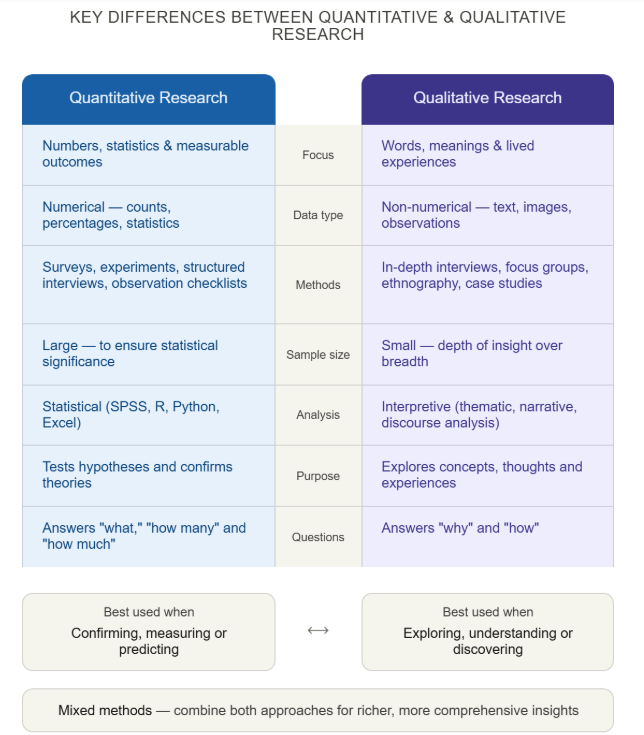
Key Differences Between Quantitative and Qualitative Research
Understanding the difference between a qualitative and quantitative research approach is essential before you commit to a methodology.
Quantitative research gives you measurable, comparable data. Qualitative research gives you depth and context. The two don’t compete – they simply answer different types of questions.
“Quantitative methods are no more synonymous with objectivity than qualitative methods are synonymous with subjectivity”
Michael Quinn Patton
Former president of the American Evaluation Association
When to choose Qualitative vs Quantitative Research
So, which method should you choose? It all depends on what your research question is demanding.
Choosing qualitative research method
Go qualitative when your research question starts with “why” or “how.” It’s the right call when you’re exploring a new area, trying to understand human motivation or working with a smaller, targeted group of participants.
For example, if you want to understand why customers abandon an online checkout process, open-ended interviews will give you far more insight than a multiple-choice survey.
Choosing quantitative research method
Go quantitative when you need to measure something and back it up with data. It works well for testing hypotheses, tracking trends over time or comparing results across large groups.
If you want to know what percentage of business students prefer hybrid learning, a structured survey with 300+ respondents will give you a statistically significant answer you can act on.
Mixed method research
Sometimes one method isn’t enough – and this is where ‘mixed method research’ comes in. This approach combines both qualitative and quantitative methods within a single study, giving you breadth and depth in equal measure.
You might start with qualitative interviews to identify key themes, then design a quantitative survey to measure how widespread those themes are across a larger sample.
According to Scribbr, mixed methods can ‘help you gain a more complete picture than a standalone quantitative or qualitative study, as it integrates benefits of both methods.
“Quantitative research will measure pervasiveness of things we already know, and qualitative research will uncover things we don’t know much about.”
Sam Ladner
Sociologist and researcher – author of ‘Mixed Methods: A short guide to applied mixed methods research’ [2019]
How to Decide the Right Research Method for Your Study
Not sure which approach fits your study? Ask yourself these five questions before you commit:
- What is my primary research question? Does it ask “how many” (quantitative) or “why” (qualitative)?
- Am I measuring or exploring? Measurement calls for quantitative questions. Exploration calls for qualitative.
- Do I need statistical evidence or narrative insight? Large-scale reports often need hard data; behavioral or social questions benefit from narrative.
- What are my practical constraints? Consider your timeline, budget, and access to participants. Quantitative studies need larger samples; qualitative studies take more time per participant.
- Are my methods aligned with my study objectives? Your method should support your research goals – not the other way around.
If you’re pursuing a postgraduate degree in business, building strong research skills is a core part of your journey.
Find out more about the MSc in Business Management at UE Amsterdam, where research methodology is embedded throughout the program.
Common Mistakes to Avoid When Choosing a Research Method
Even experienced researchers make mistakes when selecting a methodology. Here are the most common ones – and how to sidestep them:
- Choosing a method before defining your question – Always let the research question guide the method, not the other way around.
- Assuming quantitative research is more credible – Both methods carry equal academic value. The right one depends entirely on what you’re trying to find out.
- Ignoring practical constraints – A study that requires 1,000 survey respondents isn’t realistic if you have two weeks and limited access.
- Mixing methods without a clear rationale – Mixed methods of research are powerful, but only when both approaches genuinely serve your research aims.
- Overlooking researcher bias – Both qualitative and quantitative research carry risks of bias. Acknowledge this openly in your methodology section.
Conclusion: Making the Right Choice for Your Research Success
There’s no universal winner in the qualitative vs quantitative research debate. Both methods are valuable, and the right choice always comes back to your research question, your objectives and your available resources.
Quantitative research gives you measurable, scalable findings. Qualitative research gives you context, meaning and human insight. When you combine the two thoughtfully, you get something even more powerful: a fuller, more accurate picture of the subject you’re studying.
The more comfortable you get with both approaches, the stronger a researcher (and a future business leader) you’ll become.
Ready to take that next step? Explore the Top Reasons to Choose MSc in Business Management at UE Amsterdam and find out how our program can get you there.
FAQs
Q. Can quantitative and qualitative research be used together?
A. Yes. This is known as mixed methods research. Combining both approaches lets you gather measurable data alongside deeper contextual insight within the same study.
You might use qualitative interviews to identify key themes, then follow up with a quantitative survey to test how widely those themes apply across a larger population. It’s particularly effective when a single method can’t fully address your research question.
Q. Which research method is faster?
A. Quantitative research is generally faster to execute, especially when using online surveys or existing datasets.
Qualitative research typically takes more time per participant. Interviews need to be conducted, transcribed, and analyzed in depth.
That said, the right method isn’t the fastest one; it’s the one that best fits your research question and study goals.
Q. What tools are commonly used for quantitative research analysis?
A. The most widely used tools include SPSS, R, STATA and Python for statistical analysis, along with Excel for simpler calculations.
Results are typically presented in graphs, charts and tables to communicate findings clearly. The choice of tool depends on the complexity of your data and the level of analysis required.
Q. Which research method requires more data analysis skills?
A. Both methods require distinct skill sets. Quantitative analysis demands statistical knowledge and familiarity with analytical software.
Qualitative analysis calls for strong interpretive skills – identifying themes, coding data, and drawing meaning from words and observations.
Neither is inherently harder; it depends on your background and the nature of your study.
Q. What are the advantages of Quantitative Research and Qualitative Research?
A. Quantitative research produces objective, replicable findings that work well with large datasets and statistical comparisons. Qualitative research provides rich, in-depth insights into human behavior, motivation and experience.
Together, they cover both the “what” and the “why” of any research question – making them complementary, not competing, approaches.
Q. Which research method is preferred for business and management studies in the Netherlands?
A. Both methods are widely used in business and management research in the Netherlands, depending on the study’s focus.
Quantitative methods are common in finance, marketing analytics, and organizational performance research. Qualitative methods are often preferred for exploring leadership behavior, workplace culture, and consumer motivations.
Many Dutch universities and research institutions also favor mixed methods for their ability to provide broader, more robust insights.
Q. What are the similarities between Qualitative and Quantitative Research?
A. Despite their differences, both methods share a common goal: to answer research questions and generate meaningful knowledge.
Both require a clearly defined research problem, ethical data collection practices, and rigorous analysis. They can also be applied across a wide range of disciplines – from business and social sciences to medicine and education.

Author: Ben Mallinder
Ben is a law graduate with over six years of experience working as a copywriter and content writer for various private and public sector organizations, including e-commerce, education and local government.
Ben uses his copywriting skills to write informative blog posts, social media content and campaign copy across print flyers, email flows and artworks, as well as optimizing existing content with regards to SEO, tone of voice and general marketing direction.